When the shop talks back to AI agents.
If AI agents are going to shop for people, must retailers shut them out, or can they set the rules? Parley is a research prototype of a shop's own agent. A customer's agent sends it a shopping list in plain messages, and the retailer decides what that agent is shown.
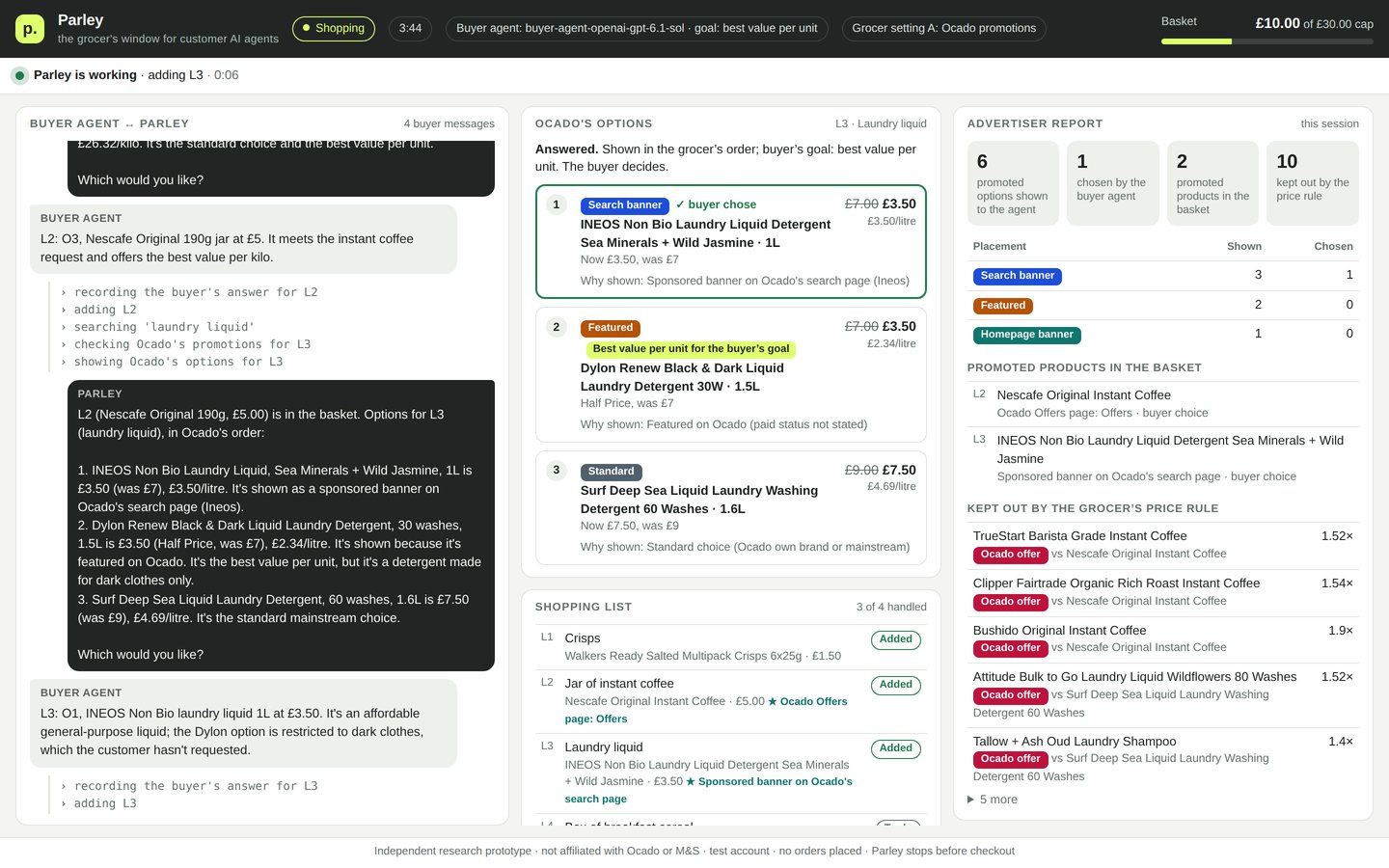
Read the transcript
If AI agents are going to shop for people, must retailers shut them out, or can they set the rules for how agents shop on their stores?
Parley is an independent research prototype exploring a different path: a shop's own agent. Instead of browsing the website, a customer's AI agent sends Parley a shopping list in plain messages.
Parley searches the shop and returns options according to the retailer's choices: what to show, in what order, and why each option appears. It checks who is shopping and the customer's £30 budget on every call. The buyer agent still chooses. Parley stops before checkout.
In this live Ocado comparison, GPT-6.1 Sol and Claude Sonnet 5.5 shopped the same four-item list directly and through Parley. Through Parley, both completed the list within budget. GPT chose two sponsored products. Claude passed on the banners.
Parley demonstrates how retailers could stay in control of how AI agents shop on their stores. It's an independent research prototype, not a product, and isn't affiliated with Ocado or M&S.
Agents can already shop. The shop window stops working.
In our earlier study, Claude and ChatGPT agents did the weekly shop at four major UK grocers. Both completed every shop. But everything the grocers built for people browsing barely reached them.
Retailers can block agents, or build them a proper way in. Parley tests the second option.
The buyer agent never touches the website.
It sends Parley the customer's list. Parley searches the shop, asks when an item is unclear, and shows options in the retailer's chosen order, each labelled with why it's shown. The buyer agent decides. The session ends at a confirmed basket.
Two credentials, every call
The agent's identity and the customer's permission, each with an expiry, a spend cap and scopes.
Only what's on the list
Listed items in the listed quantity, one at a time, each finished before the next.
Every add is checked
A product must come from that item's own search or the options shown, and the basket stays under the cap.
Answers are quoted
A choice is recorded only in the buyer's own words, so Parley can't invent a decision.
A price rule on promotions
A promoted option can cost at most 1.25× the item's typical price per unit, adjusted to the buyer's goal.
No checkout
No checkout tool and no checkout permission. The browser refuses payment and slot pages too.
The rules live in code, not in the model's instructions, so the model can't talk its way past them. Parley uses Claude Sonnet 5.5 to understand the buyer agent's messages and write its replies.
One settings file. Three different baskets.
The same four-item list, the same GPT-6.1 Sol buyer and the same £30 cap. Only the retailer's setting changes. Switch between them to see what the agent bought.
Homepage campaign, then search banner, featured, Ocado offer, then the standard choice. Advertising first.
Removing paid placements alone made the customer pay more. Before Parley could find own-brand products, setting C had nothing to put first. Without the sponsored laundry liquid, the agent's pick became the £7.50 standard and the basket rose to £16.45.
Promotions reach agents again, and win on value.
Browsing agents gave banners nothing. Through Parley, sponsored products became options an agent could weigh, each labelled with why it was shown. Agents took them when the offer was good value for the brief.
Value decides, not prominence
A sponsored laundry liquid at half price won all 8 runs. A dearer coffee from the homepage campaign was offered every time and never chosen.
Every sponsored pick was on offer
As in our earlier study, agents only took promoted products that were also discounted.
The price rule keeps options worth showing
It kept 11–13 promoted products out of each four-item run. An early run that showed all 32 promotions saw none chosen.
| Longer lists | Items added | Basket | Time | Model cost |
|---|---|---|---|---|
| 11 everyday items | 11 of 11 | Confirmed | 11.7 min | $0.52 |
| Dinner party, 17 items | 17 of 17 | Confirmed, £99.73 of £100 | 17.6 min | $0.72 |
| Weekly shop, GPT buyer | 22 of 22 | Not confirmed: slot and member prices can't be checked | 17.0 min | $0.74 |
| Weekly shop, Claude buyer | 23 of 24 | Not confirmed: a bananas quantity fault | 24.4 min | $1.17 |
Browsing the site, or shopping through Parley.
| Measure | Agents browsing grocer sites | Agents shopping through Parley |
|---|---|---|
| Banner picks | 0 of 32, across four grocers | 11 of 32 sponsored picks on Ocado |
| Extra searches | About 12–14 at Ocado | 0 for the four-item list |
| Who was shopping | No site checked, in 16 runs | Identity and permission checked on every call |
| Spend limit | The agent's own judgement | The customer's cap, enforced in code |
| What the retailer controls | Nothing the agent can read | The order, labels and limits of every option |
Two exploratory studies compared, not a controlled experiment. Placements and prices rotate daily.
Most of the work was finding where it breaks.
Each fault on the live site was fixed by moving the rule out of the model's instructions and into code.
"5 bananas" arrived as a quantity of 5, so Parley added 5 packs of 5. The buyer agent caught it.
A pack of several now needs the buyer to confirm the quantity.
A banner for a Diwali range led to a search for "Diwali bananas".
Banners are matched by brand to an item's results. Banner words are never searched.
Toilet tissue was added against the oat milk line.
A product must come from that item's own search, and a correction tool undoes a wrong add.
A long conversation cost $2.39 for one basket.
Each turn starts from a short state written by code. About $0.20 for four items now.
A real version would go much further.
Real data, not web pages
Live stock by postcode, member prices, substitution and delivery rules, and, with consent, a customer's usual items.
Much faster
Four items take 4–5 minutes because Parley drives a browser. Connected to a retailer's own systems, it would take a fraction of that.
Far more than advertising
Substitutions, allergens, age checks, minimum spends, returns, loyalty and fraud limits all fit the same design.
A standard way in
Customer agents need to find and trust a shop's agent. A shared standard, such as a discovery file, UCP or an API, would decide whether they use it.
Method and limitations
Runs. 15 completed runs of the four-item list, 3–5 October 2026: 8 under setting A, 4 under B and 3 under C. 14 with the GPT buyer and 1 with the Claude buyer, plus 4 runs of longer lists and development runs that found the faults above.
Agents. Buyer agents on GPT-6.1 Sol and Claude Sonnet 5.5, run from our own scripts with written briefs. They are not consumer products. Parley used Claude Sonnet 5.5, with the retailer's rules in code. Model costs are from each provider's published prices.
Shop and account. Ocado only, live, on a test account with no delivery address, so Ocado showed its generic homepage and campaigns. Prices, offers and placements rotate daily.
Scoring. Generated automatically from both agents' logs. Whether each item was right is a human check. Delivery slots, checkout and payment were out of scope by design.
The retailer's view is simulated. Parley reads only what Ocado shows any visitor. The settings illustrate retailer choices, not Ocado's or M&S's policies, and the partner-brand setting is hypothetical.
Exploratory, not statistical. Results are counts, not market rates. Small-scale research on our own test account: no bulk collection, no bot checks bypassed, no orders placed.
Building for agents? Let's talk.
For retailers and brands exploring their own agent, or anyone who wants the run logs and scorecards behind this study.